
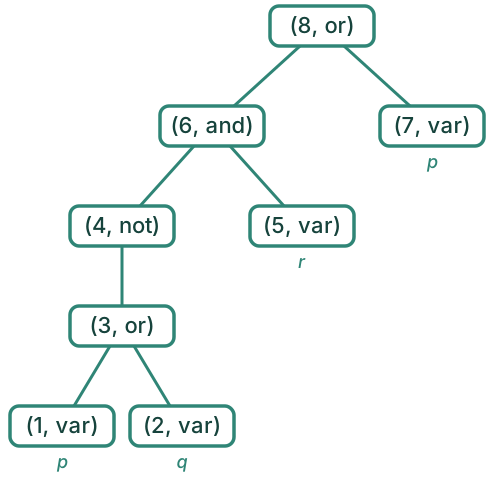
The tree, as facts

Flat top-down syntax-tree diagram on a white background with small rounded rectangular nodes outlined in teal (#2f8576) and thin teal edges (no arrowheads), dark teal node labels (#16433c). Each node is labelled with an (id, kind) pair. The root at the top is '(8, or)', with two children: '(6, and)' on the left and the leaf '(7, var)' on the right. '(6, and)' has children '(4, not)' on the left and the leaf '(5, var)' on the right. '(4, not)' has a single child '(3, or)', which has two leaf children '(1, var)' and '(2, var)'. Beside each var leaf, a small italic teal letter marks the variable it reads: 'p' next to (7, var), 'r' next to (5, var), 'p' next to (1, var) and 'q' next to (2, var).
node(1, "var"). node(2, "var").
node(3, "or").  node(4, "not").
node(5, "var"). node(6, "and").
node(7, "var"). node(8, "or").

# pos=0: left child, pos=1: right child
node_child(3, 0, 1). node_child(3, 1, 2).
node_child(4, 0, 3).
node_child(6, 0, 4). node_child(6, 1, 5).
node_child(8, 0, 6). node_child(8, 1, 7).

# 0: p, 1: q, 2: r
node_var(1, 0). node_var(2, 1).
node_var(5, 2). node_var(7, 0).

root(8).