
When is one program inside another?

Running a program is decidable and cheap; comparing two is not.

The basic question is containment: P₁ is contained in P₂ (written P₁ ⊑ P₂) when, on every input EDB, the facts P₁ derives are a subset of the facts P₂ derives — IDB₁ ⊆ IDB₂, for all inputs at once.
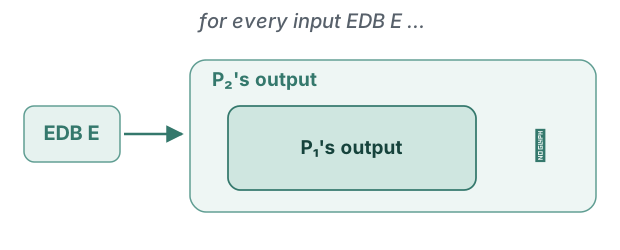
Flat set-containment diagram with rounded rectangular boxes and a directed arrow on a white background, using a teal palette. A small pale-teal box on the left labelled 'EDB E' in bold teal feeds a teal arrow rightward into a large pale-teal outer box labelled 'P-two's output' (top-left, teal). Fully nested inside that outer box is a smaller, more saturated teal box labelled 'P-one's output' in dark teal, showing P-one's output as a subset of P-two's. A large teal subset symbol appears at the right edge of the outer box. Above everything, centred, is an italic grey caption 'for every input EDB E ...'.
Equivalence is two containments (P₁ ⊑ P₂ and P₂ ⊑ P₁), and "is this rule ever needed?" is a containment too — so all of them are exactly as hard as containment.